
All-on-4 implant failure complications can affect the bridge, connecting screws, surrounding gums, or implants themselves.
A cracked, clicking, or shifting restoration does not necessarily mean an implant has failed, but it does require a dental examination to identify the cause and determine the appropriate repair.
That distinction carries real stakes. A loose screw can often be handled in one visit. A failed implant under a four-implant bridge can mean months of healing and a stretch without your usual fixed teeth.
If you already have All-on-4 dental implants, it helps to know how the system fits together. That way, all-on-4 problems feel less like a mystery and more like a set of clear next steps you can plan for.
Key Takeaways
- A broken bridge and a failed implant are different problems with very different repairs.
- Stop chewing on a damaged bridge and get it checked soon, without home tightening or gluing.
- Losing one of four implants shifts the load on the whole arch and often changes your treatment plan.
Has the Bridge Failed, or Has an Implant Failed?
In most cases where something feels wrong, the bridge or a connecting part has failed while the implants stay fused to the bone.
All-on-4 treatment has high short- and long-term survival rates but involves many steps where a complication can show up. Your dentist sorts mechanical damage from biological problems before planning any repair.
Why a Broken Bridge Does Not Necessarily Mean Implant Failure
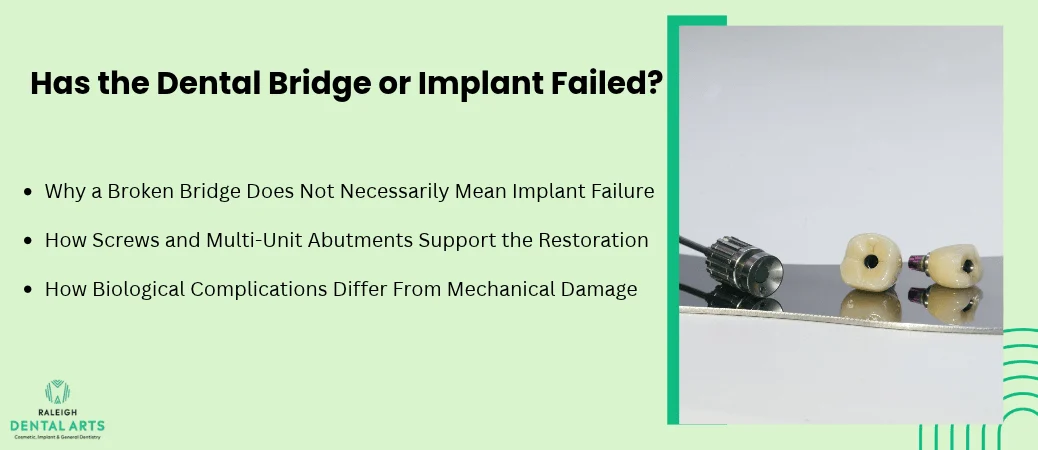
Your restoration has layers. At the bottom are four titanium implants that bond with your jawbone through a process called osseointegration. On top sits the all-on-4 bridge, the part you see and chew with.
A crack in the bridge damages that top layer. The implants underneath are anchored in bone, so a chipped tooth or a fractured section of acrylic often leaves them untouched.
Keep in mind that implant survival and trouble-free bridge service are separate measures. In pooled studies of four-implant arches, implant-level survival runs about 98% to 99% over roughly five years.
Bridges, on the other hand, chip, wear, and loosen more often than implants fail, so a high implant survival figure does not mean your bridge will go years without a repair.
How Screws and Multi-Unit Abutments Support the Restoration
Between the implants and the bridge sit small connectors called multi-unit abutments. Each one screws into an implant. The bridge then attaches to the abutments with smaller prosthetic screws.
Prosthetic screws and multi-unit abutments connect the bridge to the implants. These components can loosen, wear, or fracture under repeated biting forces.
Some damaged parts can be replaced without removing the implant, depending on the implant system, component availability, and extent of the damage.
A bridge that clicks or rocks slightly without pain often points to a loose prosthetic screw. That is a mechanical problem with a mechanical fix.
How Biological Complications Differ From Mechanical Damage
Biological problems affect the gums and bone around the implants. Peri-implant mucositis is gum inflammation around an implant, similar to gingivitis. It can often be reversed with cleaning and better home care.
Peri-implantitis goes further. It involves bone loss around the implant and can lead to implant failure if left untreated.
Bleeding, swelling, pus, a bad taste, or gum recession are common clues, and these overlap with many signs of dental implant failure.
Mechanical damage tends to show up as cracks, clicks, chips, or a bridge that shifts.
Biological trouble tends to show up as soreness, swelling, or bleeding. Some cases involve both, which is why an exam and X-rays come before any repair plan.
What Should You Do if Your Bridge Cracks, Clicks, or Moves?
Call your implant dentist and stop chewing on the damaged area until you are seen. A small mechanical issue left alone can turn into a bigger one, since a loose bridge puts uneven stress on the remaining screws and implants.
Warning Signs That Need Prompt Assessment
Book an appointment soon if you notice any of these:
- A clicking sound or feeling when you bite
- A bridge that rocks, lifts, or shifts, even slightly
- A visible crack in the bridge or the pink gum section
- A chipped or missing tooth on the bridge
- Your bite suddenly feeling different or “off”
- Pain, swelling, bleeding, or a bad taste near an implant
- A filling that seals a screw hole falling out
Contact your implant dentist promptly if the bridge moves, cracks, or causes pain. Swelling, pus, fever, or increasing discomfort may indicate infection and warrant urgent dental assessment.
Severe facial swelling, especially with difficulty breathing or swallowing, requires emergency medical care. Even a small chip should be reported so your dentist can determine how soon it needs repair.
How to Protect the Restoration Before Your Appointment
Your goal before the visit is to avoid making things worse. Here is what works in practice:
- Chew on the other side, or stick to soft foods like eggs, pasta, yogurt, and soups.
- Save any broken pieces in a clean container and bring them along. The lab can sometimes use them.
- Rinse with warm salt water if your gums feel irritated.
- Keep cleaning gently around the bridge so plaque does not build up.
- Wear your night guard if you have one, especially if you clench at night.
Avoid trying to tighten screws yourself or using drugstore glue on a cracked bridge. Home glue can contaminate the material and make a lab repair harder or impossible.
Tightening without the right torque tool can strip or break a screw.
How an Implant Dentist Identifies the Damaged Component
Your implant dentist will examine the bridge, surrounding tissues, and bite to identify possible mechanical or biological problems.
If necessary, the bridge may be removed so its screws, abutments, and supporting implants can be evaluated individually.
Dental X-rays help assess bone levels around the implants. A CBCT scan may be recommended when additional three-dimensional information is needed for diagnosis or treatment planning.
At Raleigh Dental Arts, this kind of step-by-step check is part of our restorative dentistry care, since the right repair depends on finding the true cause. Once the failed part is clear, the plan gets much simpler to explain.
Which Bridge Problems Can Be Repaired?
Chipped teeth, loose screws, and many acrylic fractures can be repaired, while a fully broken bridge or a cracked framework often needs replacing.
The bridge material and the cause of the damage shape which path makes sense.
Repairing Chipped or Detached Acrylic Teeth
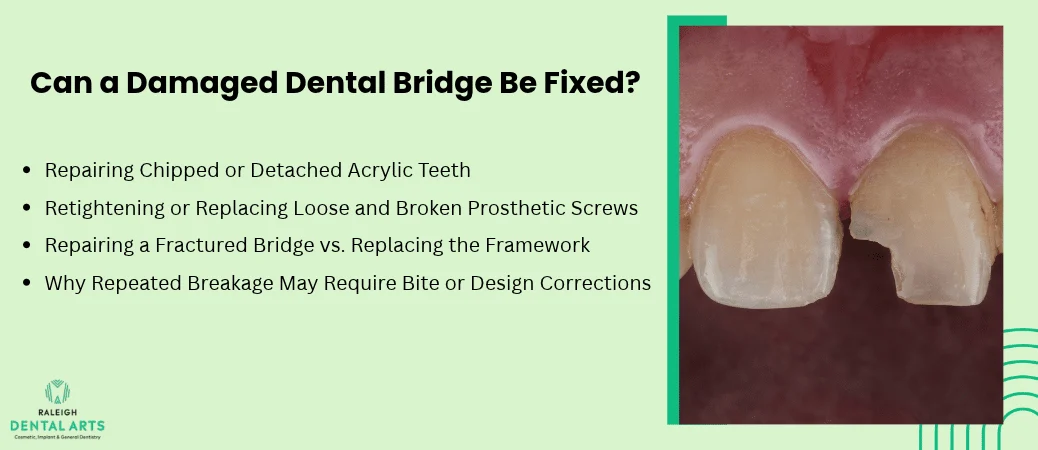
Chipping or fracture of the teeth or pink gum material is the most common technical problem with full-arch bridges. Acrylic bridges are the easiest type to patch.
A small chip can sometimes be smoothed or rebuilt with composite in the chair.
Larger repairs, such as a tooth that has popped off or a cracked gum section, usually go to a dental lab. The lab bonds new acrylic or a new tooth in place and polishes the area to match.
Acrylic restorations may gradually stain, wear, or lose their original appearance. The rate of change depends on the material, bite forces, oral hygiene, and daily habits.
Depending on the condition of the bridge, polishing, repair, or laboratory refurbishment may help restore its appearance and function.
Retightening or Replacing Loose and Broken Prosthetic Screws
A loose screw is one of the more manageable problems. Your dentist removes the filling over the screw hole, checks the screw, and retightens it to the correct torque with a calibrated tool.
If the screw is stretched, worn, or broken, it gets replaced. Broken pieces stuck inside an abutment take more work to remove, but this is still usually done in the office.
A fractured multi-unit abutment can also be swapped out, since these are standard parts.
After the screw is secure, the access hole is sealed again with tape and a composite filling. A minor bite adjustment often follows to keep the screw from loosening again.
Repairing a Fractured Bridge vs. Replacing the Framework
The table below shows how material affects the repair path.
| Damage | Acrylic bridge (on titanium bar) | Zirconia bridge |
| Small chip | Chairside or lab repair | Polish or lab repair, limited options |
| Detached tooth | Lab repair | Limited options; may need remake |
| Full fracture | Sometimes repairable; often remade | Usually remade |
| Framework crack | New bridge | New bridge |
A complete fracture through an acrylic bridge sometimes can be joined in the lab, but a weak spot often stays behind.
A zirconia bridge is stronger and resists wear, yet when it does fracture, it usually cannot be bonded back together. In that case the lab makes a new bridge, often using your old design as a guide.
Upgrading from acrylic to zirconia is a common choice for people with repeat fractures. Knowing how long full mouth implants last with each material helps you weigh a patch against a replacement.
Why Repeated Breakage May Require Bite or Design Corrections
If your bridge keeps cracking or screws keep loosening, the repair is only treating the symptom. Repeated breakage often points to something deeper.
Common causes include:
- Bruxism (grinding or clenching), especially at night
- A bite that is too high or hits unevenly
- Long cantilevers, the teeth extending past the back implants
- Thin connectors or weak spots in the bridge design
A bite adjustment spreads force more evenly across the arch. A custom night guard protects the bridge if you grind. In some cases, the bridge needs a redesign with shorter cantilevers or thicker sections.
Daily habits play a part too, so learning safe ways of eating with All-on-4 implants (no ice, hard candy, or popcorn kernels) reduces stress on the repaired bridge.
What Happens When One Supporting Implant Fails?
Losing one implant under an All-on-4 bridge usually means the bridge must be modified or taken out of service while a replacement implant heals.
Patient-level data puts this in perspective: in one large cohort, about 7% of patients with immediately loaded full-arch bridges lost at least one implant over an average of about five years. That is uncommon, but it does happen.
Why Losing One Anchor Can Destabilize the Entire Arch
An All-on-4 bridge is designed to spread your biting force across four points. Two implants sit upright near the front. Two sit tilted further back, with the back teeth extending past them.
When one supporting implant fails, the bridge may no longer distribute biting forces as originally planned.
The impact depends on the location of the failed implant, the condition of the remaining implants, and the bridge design.
Your dentist must reassess whether the restoration can remain in use or requires modification or replacement.
When the Fixed Bridge Must Be Taken Out of Function
Your dentist may shorten the bridge, unload the side with the missing support, or remove it altogether. The choice depends on which implant failed and how healthy the others are.
If an implant must be removed, the procedure depends on how firmly it remains attached to the bone and the condition of the surrounding tissues.
Your dentist will explain the removal approach and whether bone grafting or additional healing is needed.
If the bridge cannot safely stay in, you will wear a temporary during healing. This may be a 3D-printed acrylic bridge or a removable denture.
Replacement Implants, Bridge Redesign, and Temporary Teeth
Healing time after implant removal varies according to bone condition, infection, grafting needs, and the proposed replacement approach.
Your dentist may recommend additional imaging and a healing period before placing another implant. In selected cases, immediate replacement may be possible, but it is not appropriate for everyone.
If a replacement implant is not advisable, the remaining implants may be able to support a removable option such as implant-supported dentures. It is a step down from fixed teeth but more stable than a standard denture.
Why Immediate Loading May Not Be Possible During Revision
Your first bridge may have been placed the same day as your implants. That approach, called immediate loading, depends on each implant locking tightly into the bone at surgery.
During a revision, the bone at the old site may be weaker or grafted. A new implant there may not reach the tightness needed to carry a bridge right away. In those cases, your dentist will let it heal before loading it.
So even if you liked the speed of a same-day implant and extraction, same-day teeth are not guaranteed during revision. Ask early what your temporary will look like and how long you may wear it.
What Determines Repair Costs and Time Without Fixed Teeth?
Your cost and downtime depend mostly on where the repair happens: in the chair, at a lab, or through surgery. No single price fits every case, so ask for a written estimate after your exam.
Chairside Repairs vs. Dental Laboratory Work

Chairside repairs happen during your visit. Retightening a screw, replacing a screw or abutment, smoothing a chip, or resealing an access hole often fall here. You usually leave with your bridge back in place.
Lab repairs take longer. Most tooth and gum repairs need to go to a dental lab, since they are too complex to do in the chair. Your dentist removes the bridge, sends it out, and reattaches it when it returns.
A new bridge takes the longest among non-surgical repairs because it involves scans, design, and fabrication. Surgical revision adds healing months on top of that.
How Materials, Component Availability, and Damage Affect the Estimate
Several factors drive what you will pay:
- Material: An acrylic bridge is usually cheaper to patch. A zirconia bridge costs more and is harder to repair.
- Parts: Screws and abutments must match your implant system. If your original work was done elsewhere, your records help the new office order the right parts.
- Extent of damage: A chip and a full fracture are very different jobs.
- Surgery: Implant removal, grafting, and a new implant add surgical fees and a temporary.
Planning ahead for these costs is easier when you know whether All-on-4 dental implants fit your budget and what financing exists.
Questions to Ask About Temporary Teeth, Warranties, and Follow-Up
Before you agree to a plan, ask:
- Will I have fixed or removable teeth while the repair is done?
- How long will I be without my usual bridge?
- Does my original treatment include a warranty, and what does it cover?
- Are screws, abutments, and lab fees included in the estimate?
- Will you check my bite and recommend a night guard after the repair?
- How often should I come in for maintenance visits?
At Raleigh Dental Arts, we encourage you to bring any records, X-rays, or implant brand information from your original treatment.
If you are weighing a larger rebuild, it also helps to think about whether you can afford to replace your old dental work all at once or in stages.
Identify the Failed Component Before Choosing a Repair
A cracked or clicking bridge is unsettling, but the right repair starts with knowing which part failed. Bridge damage, loose or broken screws, and failed implants each follow a different path.
Chips and loose screws often get fixed in one visit. Lab repairs and new bridges take longer.
A failed implant under a four-implant bridge changes how the arch carries force, which usually means a temporary, a healing period, and a modified or new bridge.
Your next step is simple: stop chewing on the damaged area, save any broken pieces, skip home glue or tightening, and book an exam that includes removing the bridge and imaging the implants.
Frequently Asked Questions
What is the failure rate of All-on-4 dental implants?
Published research generally reports high implant survival rates for All-on-4 treatment, but outcomes vary with follow-up duration, patient health, and treatment conditions.
Implant failure is also different from mechanical complications such as bridge fractures or loose screws, which may occur even when the supporting implants remain stable.
Can I get a refund if my All-on-4 treatment fails?
Refunds depend on your original office’s policies and any written warranty you signed. Many practices offer repair or replacement coverage for certain parts over a set period.
Review your treatment agreement and ask the office directly what it covers.
Can a broken All-on-4 bridge be repaired the same day?
Some problems can, such as a loose screw, a broken abutment, or a small chip. Most tooth and gum fractures need lab work, which takes longer. Your dentist can tell you after examining the bridge.
Can I keep wearing my temporary All-on-4 teeth if they crack?
You should call your dentist right away and avoid chewing on the cracked area. A cracked temporary can shift and put uneven force on implants that are still healing. Your dentist may repair, reline, or reprint it.
Does a loose All-on-4 bridge always mean an implant has failed?
No, a loose bridge is often caused by a loose prosthetic screw, especially when there is clicking without pain. Looseness can also come from a broken screw, a damaged abutment, or, less often, a failing implant. An exam with X-rays is the only way to know which.