Wondering what to eat before sedation dentistry? The answer depends on the type of sedation you receive.
A light meal may be fine before laughing gas, while oral sedation, IV sedation, and general anesthesia may require fasting.
Your dental team’s written instructions should always come first. They consider your health, medications, sedation type, and planned procedure when setting food and drink restrictions.
Knowing these rules ahead of time can help you prepare safely and avoid delays on the day of your appointment.
If dental anxiety is the reason you chose sedation, getting the food rules right removes one more thing to worry about.
Key Takeaways
- The deeper the sedation, the longer you need to go without food.
- Water and other see-through drinks are treated very differently from milk, smoothies, or coffee with cream.
- After treatment, start with sips and soft foods, and wait until the numbness fades before you chew.
Can You Eat Before Dental Sedation? Rules by Type
How long you fast depends on how deeply you will be sedated. Light options like nitrous oxide need little prep, while IV sedation and general anesthesia need a longer empty-stomach window, often 6 to 8 hours for solids.
| Sedation type | Food and drink guidance |
| Nitrous oxide alone | A light meal may be allowed; follow your dentist’s instructions |
| Oral sedation | Fasting depends on the medication and intended sedation level |
| IV sedation | Healthy adults may be instructed to stop light meals 6 hours before and clear liquids 2 hours before |
| General anesthesia | Similar general fasting guidance may apply, with longer restrictions for heavy meals or certain health conditions |
These are general examples, not personal fasting instructions. Follow the specific cutoff times provided by your dental or anesthesia team.
Does Laughing Gas Require Fasting?
Laughing gas alone does not call for strict fasting. Most offices suggest a light, easy meal 2 to 3 hours before your visit.
If your dental team allows food before laughing gas, choose something light, such as toast, a banana, or a small bowl of oatmeal.
Avoid a large, greasy meal right before treatment, and follow any fasting instructions provided by your dentist.
If your dentist pairs laughing gas with a sedation pill, the oral sedation rules below apply instead.
When Should You Stop Eating Before Oral Sedation?
Before oral sedation, ask your dental team when to stop eating and drinking. The instructions depend on the medication, intended sedation level, and your medical history.
Some patients need fasting precautions similar to those used for IV sedation, so do not assume you can eat or drink shortly before your appointment.
Oral sedation pills can make you quite drowsy, and you may drift in and out during treatment. That is why the rules tighten compared with laughing gas.
A few practical tips help here:
- Eat a normal, balanced dinner the night before.
- For a morning appointment, plan your last meal around the exact cutoff time given by your dental team.
- Ask whether your pill interacts with grapefruit. Some offices tell you to avoid it with triazolam (Halcion).
- Skip alcohol for at least 24 hours before.
How Do Fasting Rules Change for IV Sedation and General Anesthesia?
IV sedation and general anesthesia follow the strictest rules. Expect no solid food for 6 to 8 hours and no clear liquids within 2 hours of your start time.
These timelines match the American Society of Anesthesiologists’ general approach. Clear liquids are allowed up to 2 hours before, a light meal up to 6 hours before, and fried or fatty meals up to 8 hours before, since heavy food takes longer to leave your stomach.
Here is how that looks in real life:
- 8:00 AM appointment: no solid food after about 2:00 AM (in practice, nothing after a late dinner), no clear liquids after about 6:00 AM.
- Noon appointment: no solid food after about 6:00 AM, no clear liquids after about 10:00 AM.
Some offices simply say “nothing after midnight.” If yours does, follow that.
What Can You Drink Before Your Appointment?
Before a sedation dentistry appointment, you can usually drink clear liquids until about 2 hours before your start time, unless you are told otherwise.
Anything cloudy, creamy, or thick counts as food and follows the longer solid-food cutoff.
Which Drinks Count as Clear Liquids?
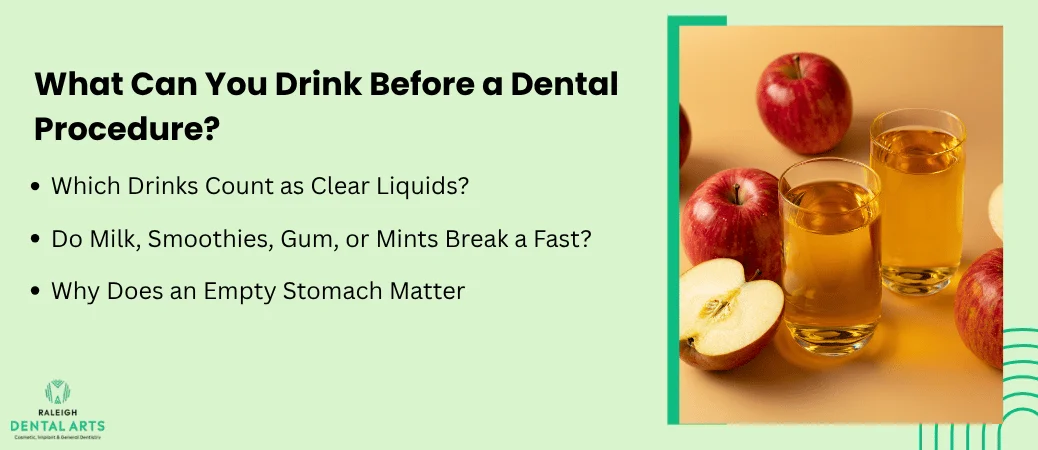
A clear liquid is one you can see through, with no pulp, milk, or fat. Color is fine. Clarity is what counts.
Common clear liquids include:
- Water
- Apple juice without pulp
- Sports drinks like Gatorade
- Clear sodas such as ginger ale
- Plain tea or black coffee (no milk, creamer, or sweetened creamers)
- Clear broth
Follow your dental team’s instructions on how much water you may drink and when to stop. Do not drink anything after your assigned cutoff time unless your care team specifically allows it.
Do Milk, Smoothies, Gum, or Mints Break a Fast?
Yes, milk and smoothies break a fast. They contain fat and protein, so your stomach treats them like a meal.
Drinks that count as food include:
- Milk, cream, or coffee with creamer
- Smoothies and protein shakes
- Orange juice with pulp
- Lattes and blended coffee drinks
Ask your dental team whether chewing gum or using mints is allowed before sedation. Some practices restrict them as part of their preparation instructions.
Remove any gum before treatment and tell your team if you accidentally chewed gum during your fasting period.
If you rely on coffee, black coffee usually counts as clear. Some offices ask you to skip caffeine before oral sedation, so confirm first.
Why Does an Empty Stomach Matter?
An empty stomach lowers your aspiration risk. Aspiration means food or drink coming up from your stomach and entering your lungs.
When you are awake, you cough or gag to stop that from happening. Under deeper sedation, those reflexes slow down or switch off.
If your stomach is full, food can travel up and slip into your airway, which can cause a serious lung infection or a breathing emergency.
The fasting window gives your stomach time to empty. Clear liquids leave in about 2 hours. A heavy meal can take 8.
What If You Ate or Have Special Fasting Needs?
If you slipped up on fasting, tell your team right away; they may delay or reschedule to keep you safe. Daily medications, diabetes, and children’s needs all have their own planning, so sort them out before the day of your visit.
What Should You Do If You Accidentally Eat or Drink?
Call the office as soon as you realize it. Do not try to hide it or hope it does not matter.
This happens more than you might think. People grab a handful of crackers out of habit or add cream to their coffee without thinking. Your team has handled it before.
When you call, have these details ready:
- What you ate or drank.
- About how much.
- The exact time you had it.
At Raleigh Dental Arts, our team can help you understand the eating and drinking instructions for your planned sedation treatment.
If you take daily medications, have diabetes, or have questions about fasting, contact us before your appointment so we can review your concerns and coordinate any necessary guidance.
How Should You Handle Daily Medications or Diabetes?
Ask your dental or anesthesia team which daily medications to take before your appointment. Some medicines may be continued with a small sip of water, while others require special instructions.
Never stop, skip, or change a prescribed medication without guidance from the clinician managing your care.
Some need a plan ahead of time:
- Blood thinners such as warfarin, Eliquis, Xarelto, Plavix, or aspirin need clearance from your team.
- Diabetes medicines, especially insulin and SGLT2 inhibitors, may need dose changes while you fast. Confirm any medication or dose changes with your prescribing clinician.
- GLP-1 drugs like Ozempic, Wegovy, and Mounjaro slow how fast your stomach empties. Food can stay in your stomach even after a normal fast.
- Other sedatives or pain medicines can stack with sedation medications.
If you have diabetes, bring a glucose tablet or clear juice in case your blood sugar drops, and ask your team when you are allowed to use it. Bring a full written list of everything you take, including supplements.
Do Children Need Different Fasting Instructions?
Children often get slightly different timelines, especially babies. A common example is breast milk up to 4 hours before sedation and formula up to 6 hours before.
Older kids usually follow rules close to adult ones. They are also more likely to sneak a snack. A few tips from parents who have done this:
- Book the earliest morning slot so your child sleeps through most of the fast.
- Keep food out of sight that morning, and eat your own breakfast elsewhere.
- Pack a favorite drink or snack for after the visit.
For extensive treatment under deep sedation, a dental anesthesiologist often manages your child’s care and will give you exact times.
What Should You Eat and Avoid After Sedation?
After sedation, start with small sips of water, move to soft, cool foods once you feel alert, and hold off on chewing until the numbness wears off.
If you had a tooth pulled, protecting the healing spot shapes what you eat for several days.

When Is It Safe to Start Drinking and Eating?
Start drinking once you are awake enough to sip without trouble. Water in small sips is the best first choice.
Hold off on real food until the numbness from local anesthetic fades, which can take a few hours. A numb lip, cheek, or tongue is easy to bite without feeling it.
Caregivers should watch closely, especially with kids or anyone who may not notice.
Expect a small appetite. Mild nausea and sleepiness are common after sedation and tend to pass the same day. Hydration comes first; don’t force a meal.
Skip alcohol entirely, since it can boost drowsiness and mix poorly with pain medicine.
Which Soft Foods Are Comfortable During Recovery?
Choose bland foods that need little or no chewing. Cool or lukewarm temperatures feel best, since numb tissue cannot judge heat well.
Good options include:
- Yogurt, pudding, and applesauce
- Mashed potatoes or mashed sweet potatoes
- Scrambled eggs
- Lukewarm soup or broth
- Oatmeal or cream of wheat, cooled down
- Cottage cheese
- Soft pasta or well-cooked rice
- Smoothies eaten with a spoon
A practical tip: stock your fridge the day before. You will not feel like cooking or shopping once you get home.
If you are recovering from a root canal, follow these root canal therapy after care instructions for additional guidance on eating and protecting your treated tooth.
After a filling or crown from restorative dentistry, you may be able to return to your usual meals once you are fully alert and the numbness has worn off.
Follow any additional restrictions related to your procedure or sedation.
What Should You Avoid After an Extraction?
After tooth extractions, your main job is to protect the blood clot in the socket. Losing it leads to a painful problem called dry socket.
For the first several days, avoid:
- Straws, plus hard spitting or swishing, since suction pulls on the clot
- Hot foods and drinks in the first day or two
- Crunchy foods like chips, nuts, popcorn, and crusty bread, which can lodge in the socket
- Sticky foods like caramel, gummies, and gum
- Spicy or acidic foods like citrus and tomato sauce, which sting
- Carbonated drinks
- Alcohol and smoking
Chew on the other side once you start chewing again. Following proper home care after a dental extraction can help protect the healing socket, while patients recovering from wisdom teeth removal may need additional precautions.
Contact the office if bleeding won’t slow with pressure, pain gets worse after day three, or you can’t keep fluids down.
Follow Your Dental Team’s Eating Instructions
Your written instructions from your own team are the rule to follow, even when they differ from the general timelines here. They factor in your sedation type, your health, and your procedure.

Before the visit, keep these points in mind:
- Laughing gas: a light meal 2 to 3 hours ahead is usually fine.
- Oral, IV, or general anesthesia: stop solids about 6 to 8 hours before and clear liquids about 2 hours before.
- Clear means see-through. Milk, smoothies, and creamy coffee count as food.
- If you slip up, call and tell your team the time and amount.
After the visit, sip water first, wait for numbness to fade, and stick to soft, cool foods.
If you had an extraction or oral surgery, avoid straws and hot or crunchy foods for several days, following your dentist’s recovery instructions.
Write your cutoff times for eating and drinking on a sticky note the night before and put it on the fridge. If anything is unclear, contact the office ahead of time.
For patients who feel nervous about treatment, understanding how sedation dentistry for dental phobia may help can make planning easier.
You can also review what to expect during your first visit so you feel more prepared for your appointment.
Frequently Asked Questions
Can I eat breakfast before laughing gas?
Yes, a light breakfast 2 to 3 hours before laughing gas is usually fine and can help prevent nausea.
Pick something simple like toast or oatmeal. If laughing gas is combined with a sedation pill, follow the stricter oral sedation rules.
Can I drink water before IV sedation?
Yes, you can usually drink water up to 2 hours before IV sedation. After that cutoff, have nothing by mouth except a small sip to take approved medicines. Some offices set an earlier cutoff, so check your instructions.
What happens if I eat before IV sedation?
Your dental team will review what you ate or drank, how much you had, and when. Depending on those details, they may proceed, delay treatment, or reschedule your appointment.
Can I drink coffee before oral sedation?
Black coffee counts as a clear liquid, but some offices ask you to skip caffeine for a few hours before oral sedation. Coffee with milk or creamer counts as food. Confirm with your team before your morning cup.
What are good foods to eat after dental sedation?
Soft, cool, bland foods work best, such as yogurt, applesauce, mashed potatoes, scrambled eggs, and lukewarm soup. Start with sips of water and wait until numbness fades before chewing.