
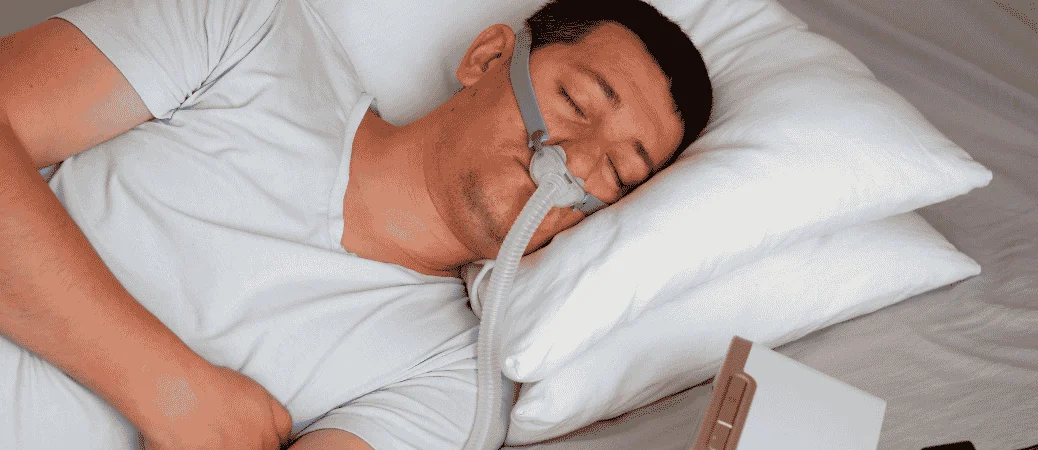
You wake up tired even after eight hours in bed. Your partner has moved to the guest room because of the snoring.
And lately your jaw feels sore or tight in the morning, which makes you wonder if everything is connected.
Those three symptoms together are worth taking seriously. Loud snoring plus daytime fatigue is one of the most common patterns behind obstructive sleep apnea, and jaw discomfort often shows up alongside it.
The appeal of a small dental device is obvious when the alternative looks like a hose and a mask.
A custom dental sleep appliance can treat sleep apnea for the right person, but it works only after a sleep study confirms the diagnosis, and it does not replace CPAP for everyone.
Some people get excellent control from a mouthpiece. Others need the pressure a machine provides, and a few have a type of apnea no dental device can touch.
Key Takeaways
- Quieter snoring does not prove your apnea is under control; only follow-up testing does.
- Custom mandibular advancement devices suit mild to moderate OSA or CPAP intolerance, while severe cases usually still need PAP therapy.
- A sleep study, a sleep specialist, and a dentist trained in dental sleep medicine all belong in the process.
Table of Content
- Could an Oral Appliance Address These Symptoms?
- How Dental Sleep Appliances Keep the Airway Open
- Oral Appliance vs. CPAP: Which Fits Your OSA?
- How to Get a Safe, Effective Fit and Monitor Results
- Choose Treatment That Controls the Apnea, Not Just the Snoring
- Frequently Asked Questions
Could an Oral Appliance Address These Symptoms?
Among the sleep treatment options available for obstructive sleep apnea, an oral appliance may help certain patients by positioning the jaw to support a more open airway.
It does nothing for apnea that starts in the brain, and jaw pain has several possible causes that change the plan entirely.
When Snoring and Fatigue Point to Obstructive Sleep Apnea
Snoring is the sound of a partly blocked upper airway. When the tissue collapses far enough that breathing stops or drops off, you get apnea events and hypopneas, and each one nudges you out of deep sleep.
That is why you can spend nine hours in bed and still feel wrecked. Your brain has been waking up dozens of times an hour without you remembering any of it.
Doctors measure this with the apnea-hypopnea index, or AHI, which counts breathing interruptions per hour of sleep.
Your AHI sorts you into mild, moderate, or severe OSA, and that number drives almost every treatment decision that follows.
Untreated OSA is linked to high blood pressure, atrial fibrillation, stroke, and heart attack. The dental side effects of sleep apnea show up too, including dry mouth from mouth breathing all night.
Why Jaw Pain Does Not Automatically Mean a Dental Appliance Is the Answer
Morning jaw soreness has a few common sources, and only some of them improve with a sleep device.
Teeth grinding and clenching strain the muscles overnight. An existing TMJ disorder can flare on its own schedule.
Here’s where the distinction matters. A mandibular advancement device holds your lower jaw forward for seven or eight hours, which is a real load on those joints.
If you already have TMJ pain, that load can make things worse before it makes them better.
A dentist should examine your joints, your bite, and your tooth health before fitting anything. If teeth grinding is the main driver, a nightguard addresses a different problem than an airway device does.
OSA vs. Central Sleep Apnea: A Crucial Difference
Central sleep apnea happens when your brain stops sending the signal to breathe. There is no blockage to open, so moving your jaw forward accomplishes nothing.
CSA needs PAP therapy and a workup for underlying causes such as heart failure or opioid use.
A sleep study is the only way to tell CSA from OSA, and that alone is a good reason not to buy a mouthpiece off a shelf and call it treatment.



How Dental Sleep Appliances Keep the Airway Open
Dental sleep appliances work by creating physical space in your throat, either by pulling the lower jaw forward or holding the tongue in place.
The custom, prescription versions are a different category of device from the anti-snoring mouthpieces sold online.
What Is a Mandibular Advancement Device?
A mandibular advancement device (MAD, sometimes called a mandibular advancement splint or MAS) looks like two connected retainers.
It pushes gently against your teeth to hold the lower jaw in a slightly protruded position while you sleep.
That mandibular protrusion pulls the tongue base and soft tissue forward, widening the space behind them.
Most devices are adjustable, so your dentist can advance the jaw in small increments over several weeks until symptoms improve.
Research on oral appliance treatment for obstructive sleep apnea shows this mandibular approach is the most commonly used design for a reason: it reduces upper airway collapse in a large share of patients.
A review of dental sleep medicine also found that MADs lower AHI values, improve oxygen saturation, and ease snoring and daytime fatigue, while noting that long-term use can produce dental or bite changes.
When a Tongue-Retaining Device May Be Considered
A tongue-retaining device (TRD) uses gentle suction to hold your tongue forward in a small bulb at the front of the mouth.
Nothing grips your teeth, which makes it an option when you are missing teeth or have dental work that cannot support a MAD.
TRDs are studied less than MADs and many people find them harder to tolerate. They remain useful for a specific group of patients, particularly those whose jaw or teeth rule out a mandibular device.
Why Custom-Fitted Appliances Matter More Than Store-Bought Mouthguards
Over-the-counter anti-snoring devices run roughly $30 to $200, while a custom appliance made by a dentist can run into the hundreds or thousands. The price gap reflects real differences.
Custom devices are built from impressions or scans of your teeth, adjusted over multiple visits, and monitored for bite changes. Boil-and-bite versions offer none of that.
They also come with no diagnosis behind them, so you might quiet the noise while the oxygen drops continue.
Where Rapid Maxillary Expansion Fits in Pediatric Care
Rapid maxillary expansion (RME) is an orthodontic treatment for children, not a nightly appliance for adults.
It widens a narrow upper jaw over several months, which enlarges the nasal floor and can improve nasal breathing.
For kids with narrow palates and sleep-disordered breathing, RME is handled by an orthodontist alongside a pediatric sleep evaluation.
Adult bone has fused, so the same expansion is not available without surgery.
Oral Appliance vs. CPAP: Which Fits Your OSA?

CPAP lowers AHI more than an oral appliance in controlled testing, but the therapy you will wear every night is the one that helps you. Severity, anatomy, and tolerance decide the match.
| CPAP | Oral Appliance | |
| Best for | All OSA severities, plus CSA | Mild to moderate OSA, CPAP intolerance |
| AHI reduction | Greatest | Good, less than CPAP |
| Typical cost | $300 to $1,200 | $30 to $4,000 |
| Common side effects | Dry mouth, mask leak, claustrophobia | Jaw discomfort, excess saliva, bite changes |
| Travel | Machine, hose, power | Fits in a pocket |
| Nightly use rates | Lower | Higher |
Why CPAP Remains the Most Reliable Option for Many People
Continuous positive airway pressure splints the entire airway open with a steady stream of air, so it works no matter where the collapse happens.
A meta-analysis of 80 studies found CPAP outperforms oral appliances on AHI.
CPAP also handles central sleep apnea and severe disease, which oral appliance therapy does not.
Many early complaints have fixes: a different mask, added humidification, a pressure change, or a switch to an APAP machine that adjusts pressure automatically.
Who May Be a Good Candidate for a Mandibular Advancement Device
You are a reasonable candidate if you have mild to moderate OSA, enough healthy teeth to anchor the device, and no active TMJ disorder.
People who cannot tolerate CPAP after a genuine effort are the other main group.
Body position matters here too. If your apnea is worse on your back, an appliance combined with side-sleeping can produce a bigger drop in events than either approach alone.
Travel is where patients notice the difference most. No power outlet, no distilled water, no TSA conversation about the machine in your bag.
When Severe OSA, Low Oxygen Levels, or Other Risks Change the Plan
Severe obstructive sleep apnea, significant oxygen desaturation, or heart conditions such as atrial fibrillation push the plan toward PAP therapy.
The margin for partial treatment is thin when your oxygen is dropping into the low 80s.
Dental problems also close the door. Advanced gum disease, too few teeth, or full dentures leave nothing for a MAD to hold onto. A periodontal evaluation sometimes has to come first.
Can an Appliance Be Used With PAP Therapy or Positional Therapy?
Yes, and combination therapy solves real problems. Some people wear a MAD with CPAP, which allows a lower pressure setting and a smaller nasal mask, easing claustrophobia and leak issues.
Others use the appliance every night and keep CPAP for nights when congestion makes a nasal device harder to use.
Positional therapy, meaning training yourself off your back, layers onto either one.
How to Get a Safe, Effective Fit and Monitor Results
Getting a dental sleep device right takes a diagnosis first, a trained dentist second, and a follow-up test third. Skipping any of those steps means you are guessing about whether your apnea is controlled.
Start With a Sleep Study and a Prescription

You need a sleep study before any appliance. A home sleep study is enough for many straightforward cases, while in-lab testing is better when heart or lung conditions are in the picture or CSA is suspected.
The study produces your AHI and oxygen data, which a sleep specialist uses to write the prescription.
A dentist cannot legally diagnose sleep apnea. That boundary protects you.
What a Qualified Dentist and Sleep Specialist Each Do
Your sleep specialist diagnoses the disorder, sets treatment goals, and interprets follow-up testing.
Your dentist selects and fits the device, adjusts the advancement over time, and watches your teeth and joints for trouble.
Look for a dentist with training through the American Academy of Dental Sleep Medicine (AADSM).
The American Academy of Sleep Medicine and AADSM jointly recommend that custom, titratable appliances be fitted by qualified dentists.
A practice offering oral appliance therapy should be able to name the sleep physicians it works with.
At Raleigh Dental Arts, Dr. Kati Hetrick has a special interest in airway-focused dentistry and non-invasive sleep apnea solutions.
She can evaluate your teeth, bite, and jaw to determine whether oral appliance therapy may fit into the treatment plan recommended for your diagnosed sleep condition.
Common Oral Appliance Side Effects and How Follow-Up Helps
Expect some jaw soreness, tooth tenderness, dry mouth, or extra saliva during the first few weeks. Most of it settles as you adapt.
Research comparing devices found jaw and oral pain plus excessive salivation occur more with oral appliances, while dry upper airway, stuffy nose, and mask leak show up more with CPAP.
The slower concern is tooth movement and bite changes over years of nightly wear.
Your dentist should record your bite at baseline and recheck it at every visit. Report new TMJ clicking or locking right away.
Does Insurance or CareCredit Cover a Dental Sleep Device?
CareCredit and most medical plans cover custom oral appliances as durable medical equipment (DME) when a sleep study documents OSA and a physician prescribes the device.
Coverage runs through medical benefits, not dental.
Bring your prescription and study results to the billing conversation, and ask whether the dentist is a contracted DME supplier. Over-the-counter devices are never covered.
Choose Treatment That Controls the Apnea, Not Just the Snoring
Silence in the bedroom feels like proof, and it fools a lot of people.
A device can quiet the sound while your breathing still stops dozens of times an hour, so ask for a follow-up sleep study with the appliance in place and compare the new apnea-hypopnea index to your baseline.
Judge oral appliance therapy the same way you would judge CPAP therapy: by measured numbers, by how you feel at 3 p.m., and by whether your daytime sleepiness has lifted.
If sleep quality has not improved after your dentist finishes titrating the device, that is information, not failure.
Start with a diagnosis, pick the therapy you will use every single night, and get retested to confirm it is doing the job.
Frequently Asked Questions
Can a dental sleep appliance replace CPAP for sleep apnea?
For some people with mild to moderate OSA, yes, and CPAP intolerance is a recognized reason to switch.
CPAP still lowers AHI more in controlled studies, so your sleep specialist should confirm the appliance is controlling your apnea with follow-up testing before you retire the machine.
Who is not a good candidate for an oral appliance for OSA?
People with central sleep apnea, severe OSA with significant oxygen drops, active TMJ disorder, or too few healthy teeth to anchor the device.
Advanced gum disease and full dentures also rule out a mandibular advancement device in most cases.
Can a mandibular advancement device cause jaw pain or TMJ symptoms?
Yes. Holding the lower jaw forward all night puts load on the joints and muscles, and jaw soreness is among the most common side effects.
Mild early discomfort usually fades, but persistent pain, clicking, or locking means you should see your dentist for an adjustment.
Do over-the-counter sleep apnea mouthguards work?
Retail mouthpieces running $30 to $200 can reduce snoring for some users, but they are not a treatment for diagnosed sleep apnea.
They come without a sleep study, without bite monitoring, and without insurance coverage, so quieter nights can mask untreated breathing events.
Do I need another sleep study after getting an oral appliance?
Yes. Once your dentist finishes adjusting the device, a repeat sleep study with the appliance in your mouth confirms whether your AHI has actually dropped.
Symptom relief alone is not proof, and this test is the step people skip most often.


